Heat wave in Europe? Our processors stay cool.
While we’re sitting at 35 degrees, thinking about air conditioners, fans, and the shortest route to the nearest lake, power electronics, embedded systems, and CPUs face a similar problem—only without the prospect of cooling off in the water.
After all, more computing power in less space almost inevitably means more heat. And this is exactly where things start to get interesting. More specifically: systematic airflow.
Not all fans are created equal.
It spins, creates a breeze, cools. Or so you might think. But it’s not quite that simple. That’s because air doesn’t always move willingly to where the designer wants it to go. Depending on the installation space, flow resistance, and required air pressure, very different fan designs are therefore used.
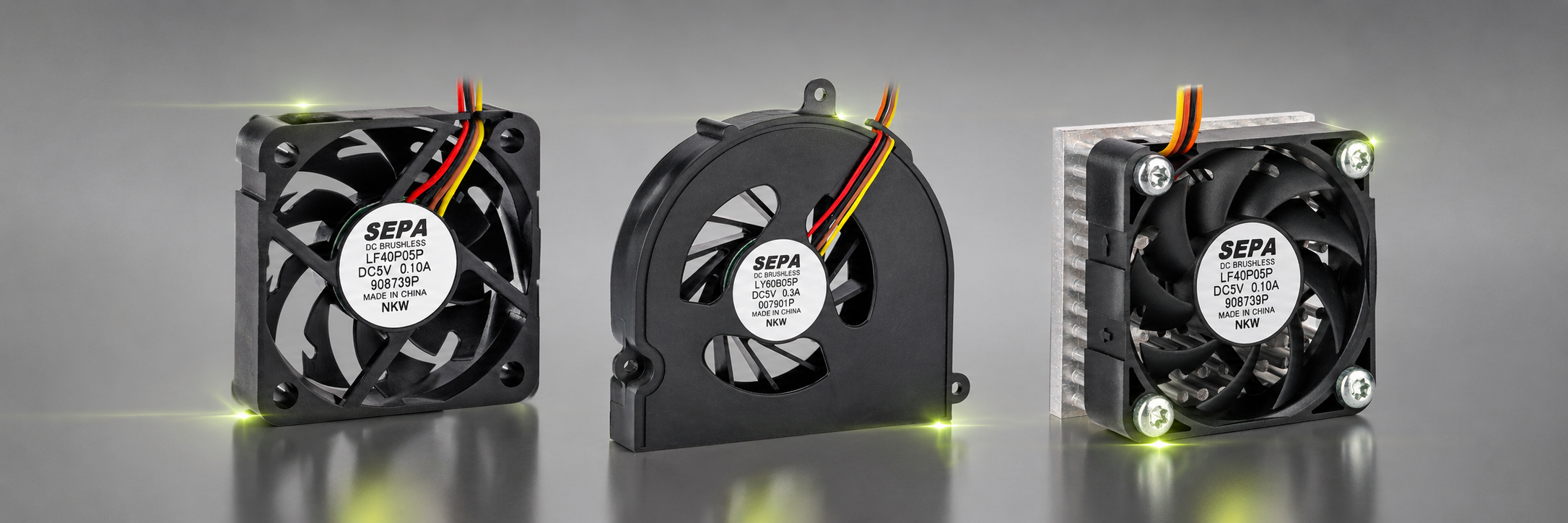
The AXIAL FAN is the classic choice. Air in, air out—parallel to the axis of rotation. This design delivers high airflow rates with comparatively low flow resistance, making it ideal for enclosures, servers, and larger electronic systems. Need to move a lot of air? It can handle it.
When the path becomes more complicated, that’s when the RADIAL FAN comes into play. It draws in air axially, accelerates it, and expels it at a 90-degree angle. The key advantage: significantly higher static pressure. If cooling fins, narrow air ducts, or filters get in the way, a radial fan is much less affected by them. True to the motto: If the air won’t flow through on its own, we’ll give it a little nudge.
And what if there’s no room for large airflows or large fans? That’s when things get really interesting. CHIP COOLERS combine a fan and a heat sink into a highly compact thermal unit located directly at the hotspot. Instead of first bringing the entire enclosure to a comfortable operating temperature, cooling takes place right where the heat is generated. This is particularly crucial for embedded systems, industrial electronics, or medical technology—because in those applications, available installation space is often just a theoretical value from the datasheet.
Four solutions. One mission: Keep cool.
Type 1: Keep it passive.
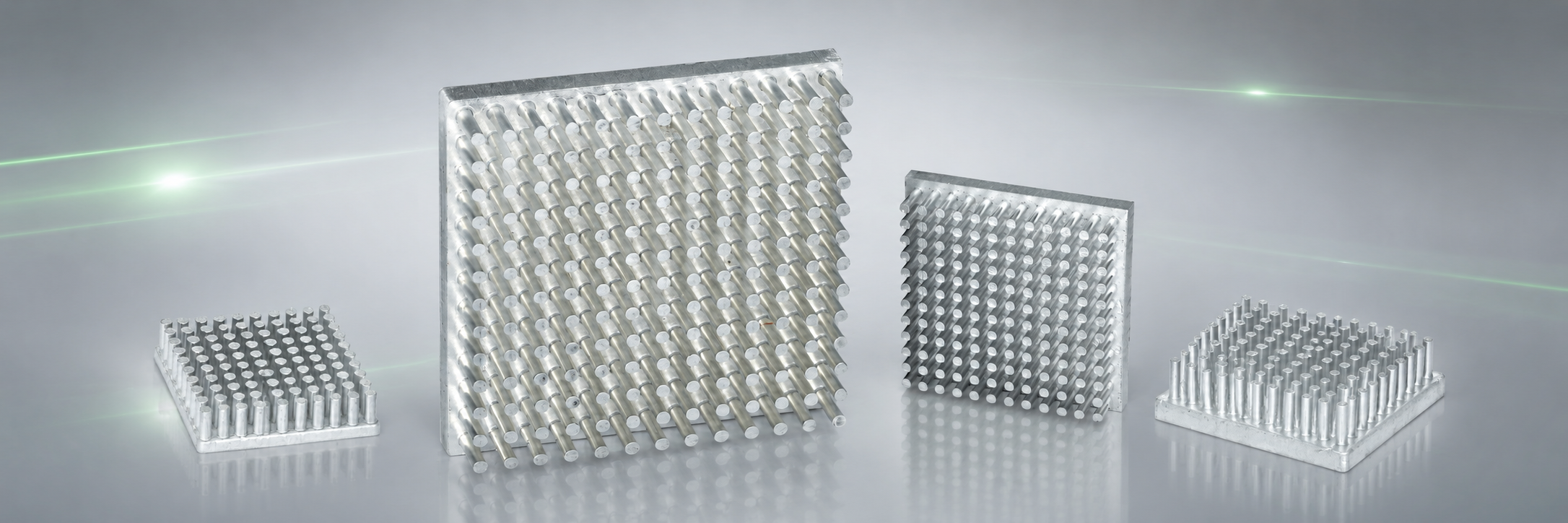
Sometimes the simplest solution is the best. The PB pin heat sinks require no fan at all and are made of pure Al99.5 aluminum. The extrusion process creates a structure that evenly transfers heat from the base plate to the pins.
No moving parts, no fan noise, practically no hassle. They are attached using thermal interface material or two-component adhesive. Ideal for small electronic components and wherever space is limited and passive cooling is sufficient.
Type 2: Fan yes. Frame no.
When more cooling capacity is needed, air comes into play. A particularly compact version combines the heat sink with a frameless 40-mm fan.
The rotor actually measures just 37 mm and requires a height of only 10 mm. Thanks to the lack of a frame, it can be integrated directly into the heat sink—perfect for embedded applications where every millimeter is already triple-booked.
The technical specifications are equally impressive: ball bearings, an MTBF of 350,000 hours at 40 °C, speed monitoring via pulse output, and PWM control ranging from about 35 to 100 percent of the rated speed. And at just 22 dB(A), it remains pleasantly quiet.
Type 3: Eight Millimeters of Engineering Excellence.
Even flatter? Here you go.
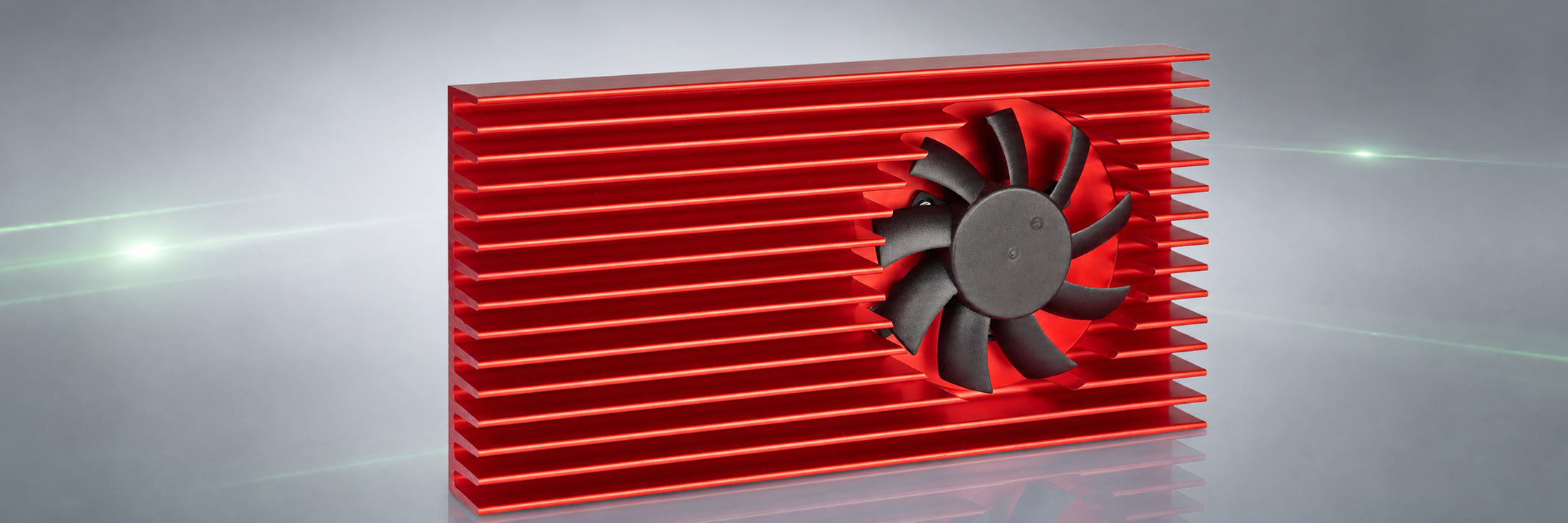
In the HZ30B, the fan isn’t mounted on the heat sink but is flush with the aluminum pin block. This reduces the total height to just 8 mm.
Staggered pins optimize airflow and enable a thermal resistance of only 4.7 K/W despite the miniature size. The entire component weighs just 11 grams.
A rather interesting combination for embedded computing, medical technology, or compact control systems: flat, lightweight, quiet, and yet powerful.
Type 4: When 4.7 K/W is still too much.
That’s where the HZB50B comes in.
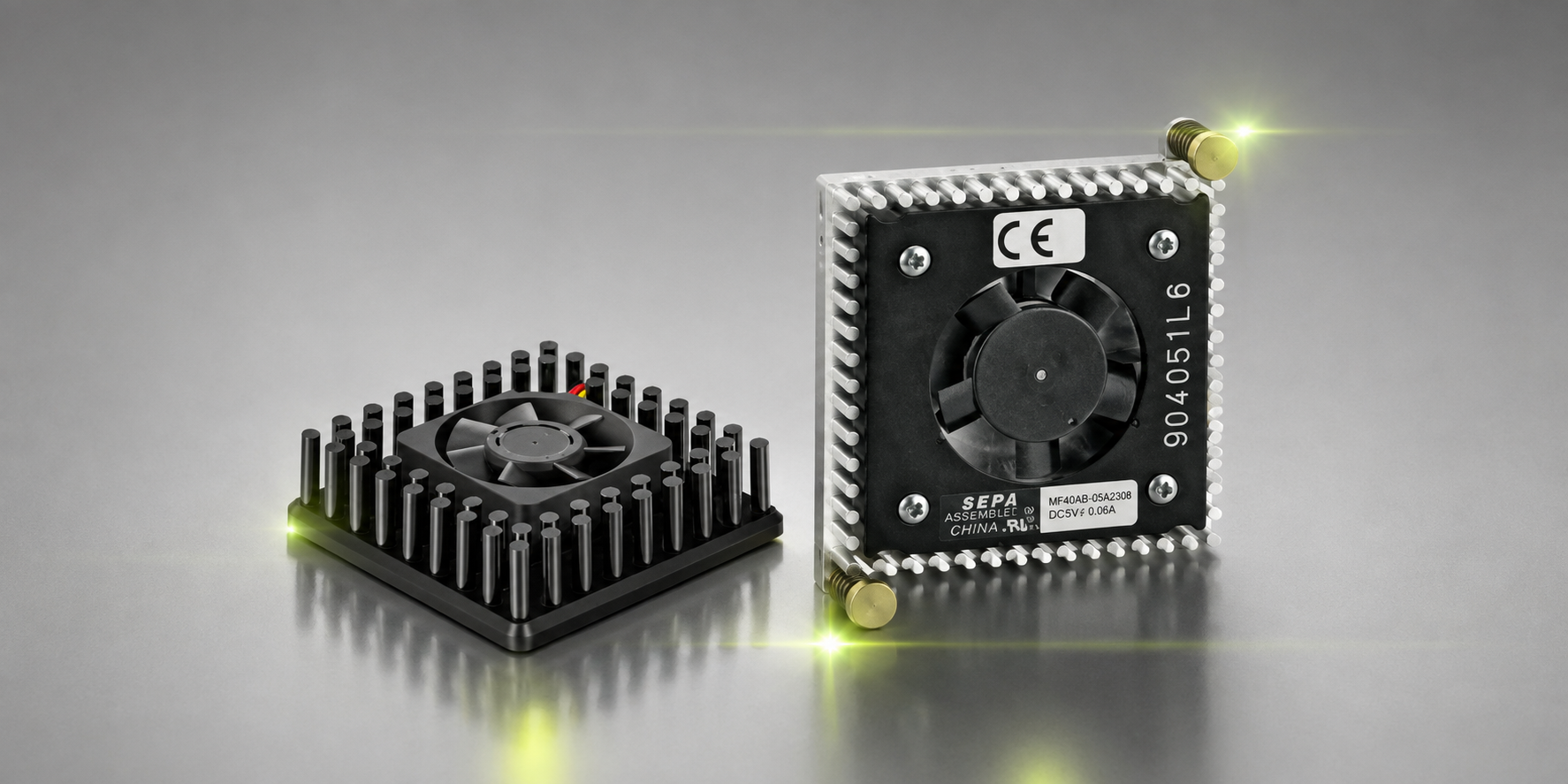
Measuring 50 × 50 × 11.5 mm, this active cooler is also extremely compact, yet achieves a thermal resistance of just 1.4 K/W.
The heat sink is also made of pure aluminum; the fan uses durable ball-bearing technology and achieves an MTBF of 350,000 hours at 40 °C. Push pins and compression springs ensure easy installation and a defined thermal contact with the semiconductor. The system is available in 5 V and 12 V versions. Small, flat—and a serious contender when it comes to thermal performance.
Four designs. One less problem.
Passive cooling, frameless fan integration, ultra-slim active coolers, or maximum cooling performance in a 50 × 50-millimeter space: Ultimately, the application determines which technology makes the most sense.
It’s cool when the entire system works right.
Good thermal management isn’t just about blowing as much air as possible onto a chip. What matters is the interplay between power dissipation, thermal resistance, airflow, noise levels, installation space, and service life.
With high-quality cooling solutions from SEPA EUROPE, NEXT SYSTEM offers a comprehensive portfolio for embedded systems, automation, medical technology, and demanding electronic applications. Systematically and competently.
Because while Europe is still debating the next heat wave, the rule for electronics has long been:
Keep cool. Stay performant.